
Extensive Watching
A unique and evidence based approach more schools should jump onto.

I’m a big fan of extensive reading. It works. If done properly, it allows students to acquire a lot of fluency quickly (so long as equal attention is paid to speaking). Our lesson library has 1,000s of leveled readers available to teachers who subscribe (link to access sent seperately).
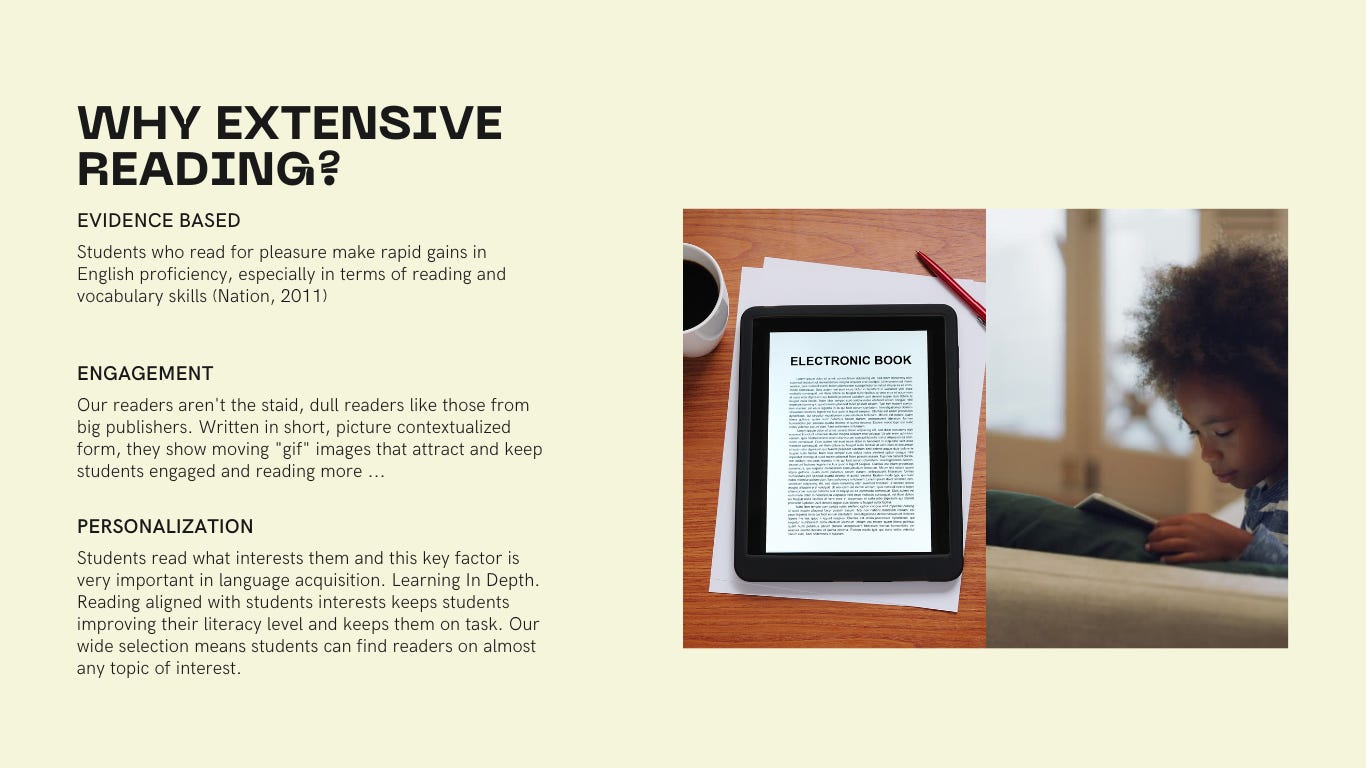
However, the rub these days is that many students don’t want to nor like reading. It’s just a fact that I’ve run across time and time again in the classroom. I think it has to do with;
a) Visuality being an ever present force and medium now – through the internet, TV, film etc…
b) Communication. Youth are so connected, never alone and a book entails the place and discipline. A book is in their head, the images in their head – something is never shared. A film / video has an objective visual reference and is more shared/social.
So the option is extensive watching. Watching videos with subtitles at the correct level as comprehensible input. Our YouTube channel is full of these videos for use and recently we’ve begun creating “storybooks” - videos that provide text and narration. See the full playlist but here is an example. Get the resources in the Lesson Library here »>
But if interested in this approach, here are my 10 characteristics of a well designed Extensive Watching program. Download as a PDF »>
The Characteristics of Extensive Watching
1. Students WATCH as much as possible. (preferably outside of the classroom – following the flipped model of the language classroom)
2. A variety of videos/film is available in a variety of genres and topics so as to encourage watching for different reasons and in different ways.
3. Students select what they want to watch and have the freedom to stop watching when the video fails to interest them.
4. The purposes of watching are related to pleasure, information and general understanding. The purposes are determined by the nature of the videos and the interests of the students.
5. Watching is its own reward. There are few exercises after watching and only for quickly reinforcing the material.
6. The videos are well within the linguistic competence (level) of the student. Video gives context and allows for a “wider” leveling. Dictionaries are used after the viewing and rarely during the watching of the video. Subtitles in the L2 may or may not be used depending on the objectives of the learning.
7. Watching is both shared and individual. Videos if possible, to be discussed and used as scaffolding material into purposeful communication and speaking practice.
8. Watching speed is at the natural rate of the media’s speakers. Whole watching is the recommended practice rather than stopping and reviewing video.
9. Teacher’s orient students to the goals of the program (communicate the rationale), explain the methodology (how to) and track what students watch, and guide students to get the most out of the program.
10. The teacher is a role model and watcher. They participate and watch what students watch. The extensive watching classroom is a place of equality and a decreased power dynamic between teacher and learner.
To wit: Extensive Watching works and fosters student self learning and monitoring. It also has the added benefit of having pragmatic features of language (body language, postures, gestures etc…) that help the learner immensely (think of how a baby “makes meaning out of sound”).
