Language Immersion
It's a term often bandied about - but what is it exactly? How to make it happen in your own classroom?

** View the presentation slides >>> Download as a PDF >>>
An Introduction to Language Immersion

What is Language Immersion?
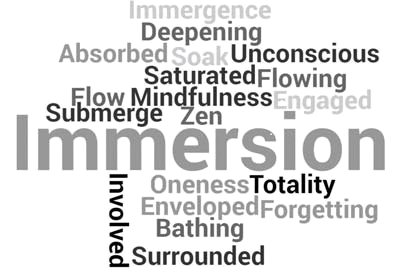
Language immersion is a powerful approach to teaching a second language where students learn the target language indirectly, not as a subject itself, but as the medium through which traditional school subjects and content are taught.
The Cambridge English Dictionary defines immersion as:
“the fact of becoming completely involved in something.”
“the process of learning a language or skill by using nothing else but that language or skill.”
This approach is known by various names and labels, including:
Content-Based Instruction (CBI)
Bilingual Education
Content and Language Integrated Learning (CLIL)
English as a Medium of Instruction (EMI)
Dual Language Approach
Despite the different terms, the core principle remains the same: students acquire the target language (L2) through meaningful and contextualized use.
The Philosophy of Immersive Learning
Many of us have experienced the magical moment of learning without consciously realizing it—a state of being completely “immersed” in the experience. This aligns with the concept of “flow,” the psychology of optimal experience as described by Mihaly Csikszentmihalyi in his seminal book, Flow: The Psychology of Optimal Experience.
The ultimate goal of this approach is student autonomy. To paraphrase the educator Maria Montessori: “The greatest sign of success for a teacher is to be able to say, ‘The children are now working as if I did not exist.’”
Implementation and Context
Language immersion has been implemented with varying degrees of success in many countries and school systems, with famous programs beginning in Canada and Singapore in the 1960s and 1970s.
The success or failure of these programs depends on a multitude of factors, including:
Government investment and policy
Teacher quality and experience
Local culture
Financial resources and funding
Access to the target language outside the classroom
Rich language environments
Stakeholder acceptance and support
Classroom delivery and implementation
Here below, I will focus on the final factor—classroom delivery and implementation—and will offer teachers practical ideas, strategies, and “ways” to activate effective immersion in their own classrooms. I find this part, the key to the success of a language immersion program - the proof is always not in the pudding but the eating!
A bit of an aside and some background. I was one of the original Canadian students (grade 6), to experience “French Immersion” classes in 1972. The Canadian model of French Immersion is often described in the literature and held up as a model of a successful language immersion program.
Well - yes and no. I took years of French Immersion classes, included one full year in a French school. Upon graduation, my French was still at best A2 level. It wasn’t until after schooling, living in France, that I became fluent and bilingual. The idea of French immersion is good - but the problem is in the implementation - too often under-skilled teachers, bad methodology and delivery of the program.
Why is Language Immersion Important?
Language immersion is widely understood to be the best approach to learning a second language. It’s evidence based and SLA research supports its methodology.
Its success is rooted in two important factors: 1. the structural framework of the program and 2. the pedagogical methods employed within it. But what exactly is a “language immersion” program?
The Core Features of Language Immersion
Swain and Johnson (1997) identified eight core features of a language immersion program:
The L2 is the medium of instruction.
The immersion curriculum parallels the local L1 curriculum.
There is overt support for the L1.
The program aims for additive bilingualism.
Exposure to the L2 is largely confined to the classroom.
Students enter with similar (and limited) levels of L2 proficiency.
Teachers are bilingual.
The classroom culture is that of the local L1 community.
These features are critical to the success of any language immersion program. There may be different entry points, but an early start (grades 1-3) is generally recommended.
The additive nature of language immersion is fundamental. In this model, the target language builds on and works alongside the native language (see translanguaging). This contrasts with subtractive bilingualism, which often occurs among immigrants who learn a new L2 in class but gradually lose proficiency in their mother tongue.
Implementing Language Immersion: The How
Program design can vary, but all immersion teaching rests on the principle that the classroom experience should be implicit and natural, moving beyond traditional explicit instruction. Students are active participants, using the L2 for learning. While social language develops quickly, teachers must deliberately attend to and build academic language proficiency.
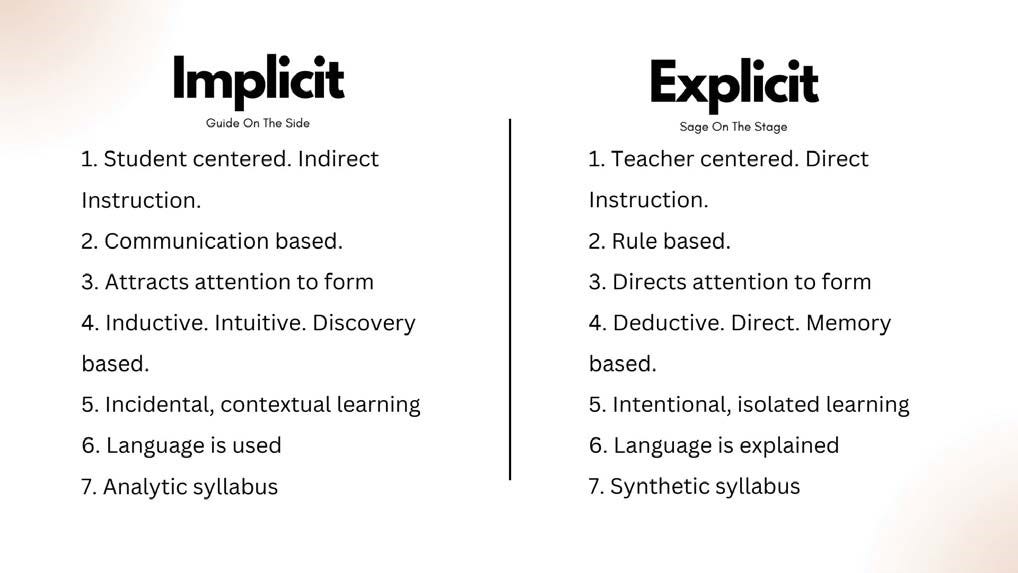
Methods
Teaching methods in immersion classrooms should be student-centered and bottom-up. Effective approaches are inquiry-based, including:
Question-Based Learning
Problem-Based Learning
Project-Based Learning
Task-Based Learning
Through these methods, students learn together by investigating, sharing, and constructing knowledge using L2 materials. It is key to engage students through their own interests, giving them choice in how and what they learn. The Learning in Depth approach (Kiernan Egan) is viable here, allowing students to apply core concepts and vocabulary to a personal topic of passion.
Blended learning is also essential. Self-directed online learning, either in class or at home, can be highly effective. The “flipped classroom” is one such model.
Content Knowledge
While a textbook often provides the syllabus, it is essential for teachers to extract the core concepts and vocabulary students must learn in the L2. Ideally, students should be involved in this process. For each unit, have students skim the content to identify key elements themselves before the teacher supplements the list.
Instructional Strategies for the Immersion Classroom
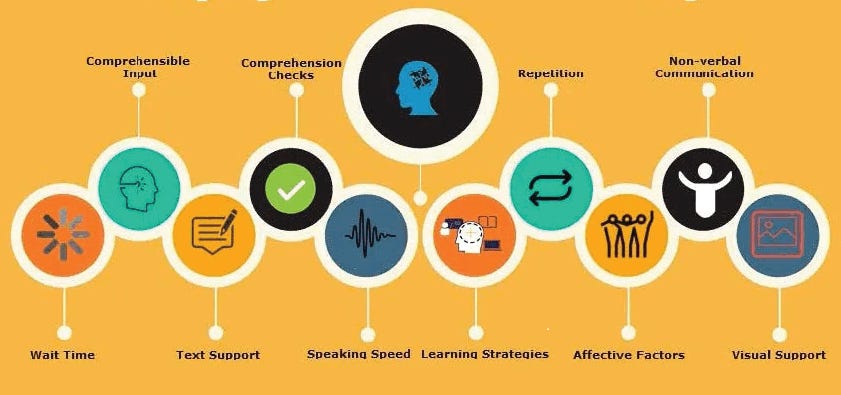
Teachers can use numerous strategies to support student comprehension and language acquisition:
Wait Time: Pause after asking questions or giving instructions to allow students time to process the L2.
Comprehensible Input: Adjust and filter your language to the students’ level. Use level-appropriate reading materials.
Speaking Speed: Slow down by pausing between thoughts and sentences, but avoid unnatural “teacher talk.”
Non-Verbal Communication: Use body language, especially facial expressions, to support understanding.
Writing: Support spoken language with written text on the board or on paper for student reference.
Student Strategies: Teach students how to request clarification, use a dictionary, take notes, or seek help from a peer.
Visual Support: Consistently provide images and diagrams to illustrate spoken content.
Comprehension Checks: Check for understanding by having students repeat or summarize what was said, rather than just asking “Do you understand?”
Repetition: Use consistent set phrases and language cues so students can focus on content.
Affective Factors: Maintain a positive, low-anxiety classroom. Encourage risk-taking, laugh at mistakes, and foster a collaborative environment where students help one another.
Classroom Activities
Learning should be discovery-based and student-centered, emphasizing active use of the L2.
Grouping: Use teams and pairs, rotating them regularly. While pairing strong and weak students can be beneficial, prioritize personality and learning disposition matches. The teacher’s role is to “step aside” and let students drive the learning, even having them teach each other.
Reading and Writing: Challenge students with extensive, level-appropriate reading. Have them summarize readings using graphic organizers, presentations, or discussions. Student writing can include creating their own “mini-books” on unit content with drawings and labels.
Stories: Leverage narrative by using stories to illustrate concepts. Investigate the TPRS methodology (Teaching Proficiency through Reading and Storytelling) and create class stories using target vocabulary.
Keep It Real: Make the L2 a living language. Bring in guest speakers, connect with other classrooms, go on excursions, and engage parents as part of the “immersion team” to create opportunities for language use outside the classroom.
Language-Rich Environment: Create an immersive physical space. Label the classroom, display posters, and maintain a library of L2 books. Engage students in designing this environment.
Forgiveness: Acknowledge that learning and teaching in an L2 can be stressful. Cultivate a habit of starting anew each day, learning from what went wrong, and practicing forgiveness to vanquish frustration.
References & Further Reading
Johnson, R. K., & Swain, M. (Eds.). (1997). Immersion Education: International Perspectives. Cambridge University Press.
Deubelbeiss, D. (2022). Strategies To Support English Language Learners. ELT Buzz Teaching Resources.
Csikszentmihalyi, M. (1996). Creativity: Flow and the Psychology of Discovery and Invention. Harper Collins.