
Our Teaching Styles
What is your "style" when teaching? Your style is how others see you and you definitely have one! Find out which.


In education, we talk a lot as teachers about philosophies of teaching and our beliefs about learning but not so much about teaching styles.
Most teachers I think will agree, we all have our own unique “style”. Some of us are quiet and calm. Some of us are loud and energetic. Some of us have desks all neatly organized, clear and many of us have desks that appear chaotic, tired, as old rag and bone shops of the heart. Some of us teach from the front of the classroom and others are everywhere.
We do what we need to do, to get the job done. So styles do flux and change, given circumstances - that is what good teaching does.
Probably the most common way to think of teaching styles is that of a spectrum of decision making. Ranging from full control by the teacher to none at all. It’s best epitomized by that developed in the 1960s by Mooston.
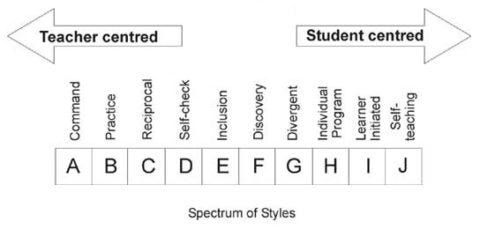
For me, a teaching style is really just how our philosophy of teaching manifests and is actualized in the real world, in the test tube that is a classroom. Think of your own past teachers, each one probably had a defining style.
Here is a list of some that come to mind, but there might be many others to add. Read and think of which ones you definitely aren’t. Also, think of which ones are close to how you manifest, act in the classroom.
The Drama King/Queen - They excite students with tricks, looks, tell jokes and stories.
The Technophile - Always using tech, always with cool slides, the latest tool and gadget in use.
The General - A teacher that lectures and spends much of class time in direct instruction mode, everything numbered and in orderly steps, stages.
The Philosopher - Poses stimulating questions, a socratic method. Reflective. Probling for meaning. Focused on critical thinking, the thought process.
The Pragmatist - They focus on life skills, the basics. Definitions, mastery before performance. What’s important is use, the wider world beyond the classroom.
The Creative Type - Role plays, art, poetry, reading, thinking outside the box.
The Manager - A teacher’s job is to oversee, assess. Students do their work, they supervise. They want students to master the facts!
The Egalitarian - This teacher takes a democratic approach, even doing what students do. Fairness is paramount. Vote on everything. Co-operative learning. Group, project work.
The Coach - They have an active classroom. Movement. Practice. Repeat. Memorize. Drills. Structure.
The Kind Soul - Motherly. Animal lover. Touchy - feely. Earthy. Environmentalist. Romantic. They want to help you change the world.
The Administrator- Worksheets. Paperwork. Fill in. Submit. Mark. The classroom is a kind of learning factory.

But I think that there is a “style” that goes beyond just what you do in the classroom and more into the heart and “how” you do it. It is that quality of “grace” that we can see in some special teachers. They have “STYLE” and it isn’t important what teaching style they use but that they have this “STYLE”.
Good teachers have a presence, they have command and authenticity. They fill up and fill out the room, be they quiet or bold. Good teachers have “STYLE”. So what is this?
As Bukowski tries to define it — I think style is something incommunicable, something we can only be partly aware of. A force of life and the sum of experience, the energy of a mind that has struggled with life emanating to be felt by many….
Still, I think we can point to a few practical things that STYLE is……
1. A love of what you are doing.
Teachers that have STYLE are THERE. Nowhere else. Not with their stock portfolios, not dreaming of the golf course, not hoping for the bell, not passing through……
2. The LOOK.
I don’t know what it is but teachers with STYLE, like Sydney Portier in “To Sir with Love” have the LOOK. They see right into you with almost superpower vision. They hear what you don’t even say! They have an almost otherworldly communication style.
3. The PERSONAL.
“A style can’t be copied, it’s unique. It can’t be bought, it can’t really even be taught (like a teaching method/style), it can only be possessed. Even failure can be a kind of “Style”….
What do you think? Do you have it? Can you get it? How? It must be important, for as Bukowski says, “STYLE is the answer to everything” and I think that is something every teacher would want!
PS. Teachers also have a classroom managment style. You can download and do a quiz here, to find out what yours is. Also, see our full post on Classroom Management!
Basically, these styles are of 4 types, a sliding scale from most control to the least control.


I feel like I'm a combination of all of them. Or at least like 5 or 6 of them.
NotebookLM fake podcast. :-D