
There Are No Shortcuts
Especially in this age of AI, both teachers and students need to know this one salient fact of education.

“The joy of learning is as indispensable in study as breathing is in running.” - Simone Weil
A number of years ago, I was attending a TESOL conference in Atlanta. Early one morning, I went to Denny’s for one of my favorite things about America - a huge, greasy breakfast.
I sat at the diner table, beside a gentleman dressed in a nice, smooth as can be suit. We eventually started up a conversation and some back and forth banter ensued. In America, this is common and a 2nd favorite thing - random banter.
I told him why I was in Atlanta and he told me he was there for the same reason - a conference. I asked him what he did. He said he was a farmer.
I looked at his hands, his suit, his skin. Something didn’t quite match up. So I probed further and found out he’d been born and raised in Chicago. An MBA from a good school. He’d recently bought a 700 acre soyabean farm in Iowa. He said he’d always dreamed of being a farmer.
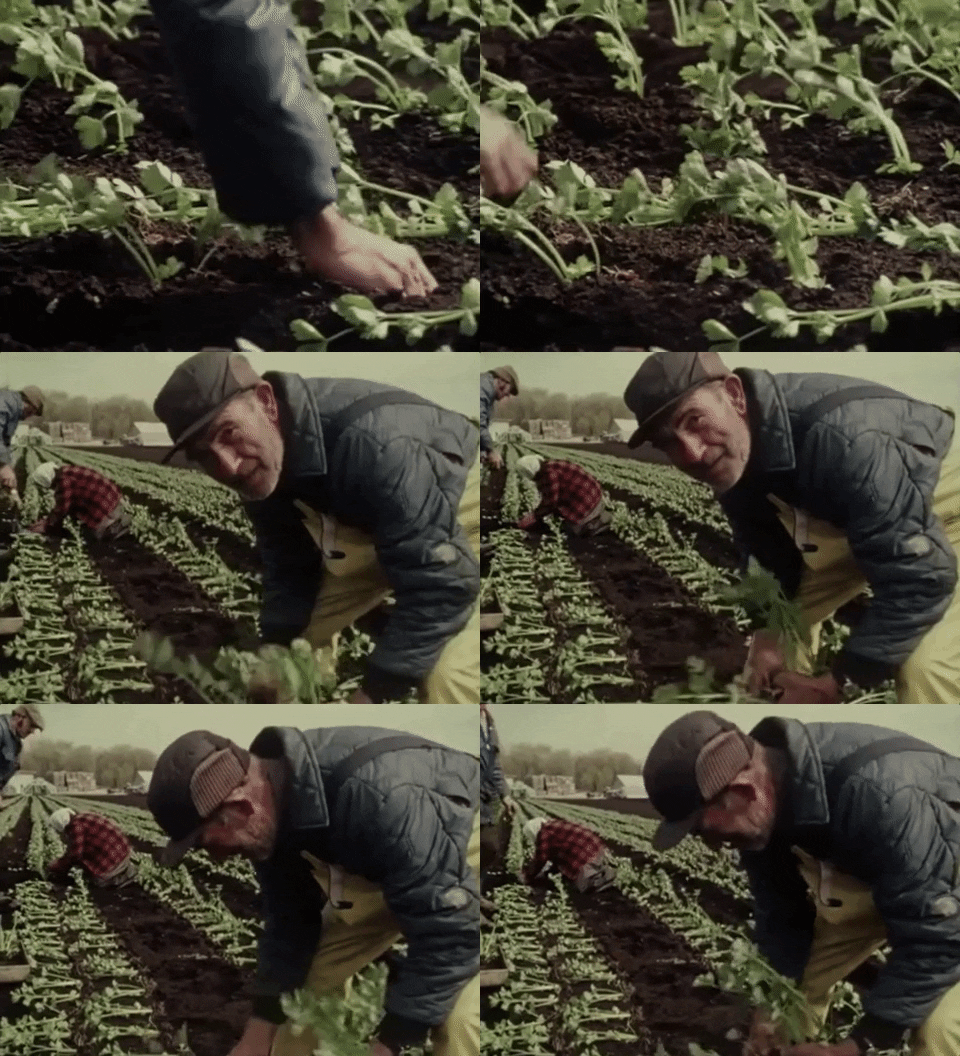
I recount this story by way of discussing what it takes to “learn” and become a “knower” or even more succinctly, someone skilled and a competent expert in a field. It isn’t by way of a production and ownership of a product. It’s about taking the time to do the work on the ground, get your mind dirty, studying hard … it’s both a struggle and a journey - a process.
As a poet, I’m asked from time to time, “How do I become a poet?” There is no secret, people, I reply. Do the work. READ, READ, READ. Writing is the sweet sauce of a person whose done the work of reading, collecting the pollen.
As a former ultrarunner and now accomplished ultracyclist, I know that no fitness comes without doing the work. There is no secret, people. You can ride a $10 bike or a $10,000 Colnago - both will get you equally fit. The tech doesn’t matter when it comes to fitness. You ride both hard, you do work on both, you’ll feel the improvement, the health that comes. Same with intelligence. Doesn’t matter, a $1 million dollar super computer or an old Popular Mechanics magazine will equally reward you with learning how to unclog a drain. There are no shortcuts.
And that’s what we’ve got so wrong about “AI” in education. We confuse the process with the packaging, as an end result. To wit: this man was no farmer, no matter how many farms he bought. Why? He didn’t do the work.
Will we create many students who are like this “farmer”, one of name only? Not versed, competent, intelligent in their domain of knowledge but possessing a piece of paper saying they own it and thus, are it? Why do we as a society stay on the road to this fakery, this “catch me if you can” ruse?
LLMs and technology in general provide a false sense that there is a shortcut to “knowing” and “learning”. Use AI and you’ll instantly be smart! You can do anything. Use this ed-tech and we’ll make everything so much easier! Our society for many years now, has bought into this, been sold this bill of goods, this yellow brick road to Oz.
We need to ignore this hype and capture of education and acknowledge that LLMs are designed to wholesale, by-pass the learning pathway, the natural development of thought, intelligence and becoming a knowing person. We need to say no to this arrested development and may I say, “con job”.
We need to avoid the alluring “salesjobs” like this and look eye to eye and say - There are no shortcuts. Do the work.

Feynman, the eminent thinker, physicist as he is, adroitly puts it to us straight. There is no secret, people. Do the work. Be interested and curious and dig in. That’s the only way. Book, thoughts, magazines, videos, conversations, search engines, experiences … all these things mix if you engage your ego in experiencing them and they “grow” knowledge and expertise in you. There is nothing instant or even quick about this - its work. There are no shortcuts. Read more about Feynman’s technique - how to master and truly learn any topic/subject.
I’ve always told my students throughout the years - do your own work. I want to know what YOU think. Write your own thoughts. Think for yourself. (and question orthodoxy/technology).
You can’t lift 100kg, if you don’t lift 50 kg constantly over many months. As Richard Hamming puts it “You must do the work.” (video below). They don’t give out certificates of marathon completion to you for just signing up (though I’m sure they are on the verge, the way we’re heading).
I read much about how we need to prepare students for an “AI” future. We need to teach AI literacy and allow students to co-create with LLMs and generative AI. We need to embed this tech into the very heart of school or we’ll be back in the stone age.
Poppycock. The thing itself is not going to do anything to make learning happen (though it might make it not happen). Latent structure rules obvious structure, once said Heraclitus. AI yes, will be part of society and students will have lots of time to access it once they leave school. But for school, learning, let’s keep things aligned with “doing the work”.
Learning happens inside - it’s an invisible process. It’s not dependent on the form of media and information sources. To use a cooking metaphor - you can make great bread with just your hands and a wooden bowl. A mixer may help you produce “more of” something but it alone will not make you a better baker. Learning to bake takes practice, time on task, doing the work, learning, discussing and testing and trying … yes, trying. And so much more. Learning is messy (AI is not).
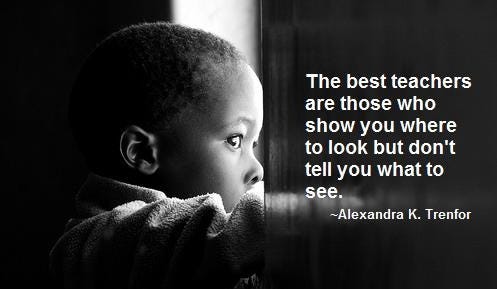
Here is an oft referenced quote about learning/teaching. I agree but with the caveat that AI (search or not) isn’t a place to look. It isn’t a source but a bottleneck. A reassemblage that is often inaccurate, biased, misleading and with the allure of authority (the Halo effect), smiling you into passive agreement. Teach students to really LOOK, dig in and down - that’s how they’ll learn.
Many are concerned with cognitive off-loading. I am too. There are times when machines should replace human thought (collation, chunking, data management, verification and more …) - but not when it comes to learning and the supple, early sprouting time of school. However, I’m much more concerned with the propensity to just surrender, cognitive surrender. Students won’t even LOOK anymore.
I know a little about human nature, I’ve seen surrender in myself - the tease and allure to just “this one time” by-pass doing the work and just let an LLM do it.
And then the slide happens and you use it more and more, justifying it more and more … and pretty soon, you are just pushing buttons and pretending you did run that marathon. I’m being honest here. Not to mention the embedded addictive ingredients and tricks it uses. Tech doping. It will get you if you open the door.
So much in school needs to be faced up to and reformed. Grades, this great push towards a result and away from the “doing”. Tech over-spend. The waste of dollars when knowledge doesn’t need this kind of addictive, distractive interference. A move away from education as a cultural ritual, a “pass Go, collect $200” game board, empty postponement of living. A move towards an education where students are interested and involved in what they are learning and doing the work because they enjoy it. The engaged ego, volition is so important to the act of learning.
I’ll leave you with Richard Hamming’s sterling advice to students - what he’s told every class he’s ever taught. This piece isn’t meant to be anything more than a cheer, a plea, to take back the reigns of education and put them into human hands. For us teachers to once more tell our students - there are no shortcuts. Do the work. Avoid the AI, the tech shortcut delusion. Or we risk providing students with token knowledge.
Read more of my thoughts about education, teaching resources and AI - use my Get Lucky tool. Serendipity is so filled with process.
