“Generative AI has the potential to change the world in ways that we can’t even imagine. It has the power to create new ideas, products, and services that will make our lives easier, more productive, and more creative. It also has the potential to solve some of the world’s biggest problems, such as climate change, poverty, and disease.” - Bill Gates, spoken on some downtime from Epstein Island.
I have to admit, I’m suffering. Terribly suffering. My ailment? A serious case of AI fatigue. I can’t go online and avoid hearing the shrivelous chorus of AI hype paraded as holy gospel (NOT).
I get it - that many teachers just see the shiny object, so desperately wish for a panacea and don’t know much about what is really happening under the AI hood (machine learning training, massive data, cool linear algebra).
They believe LLMs “think” and that LLMs actually read whatever they give it. They don’t. They are an error filled, false, cheating, mechanical turk and come with a shitload of ethical concerns to boot. Ok, I get that many just will ride the wave. But they hype - it is just too much to bear.
I’ve been around the ed-tech block a few times. I’m no spring chicken when it comes to ed-tech; running ed-tech companies, my own education, training teachers and always trying to promote the judicious, reflective, purposeful use of technology for the sake of learning. See some testimonials if you doubt my experience. But, I repeat, the hype, it is just too much to bear.
Few people have helped more ESL/EFL teachers learn about using technology than David Deubelbeiss, founder of EFL Classroom 2.0.” - Larry Ferlazzo.
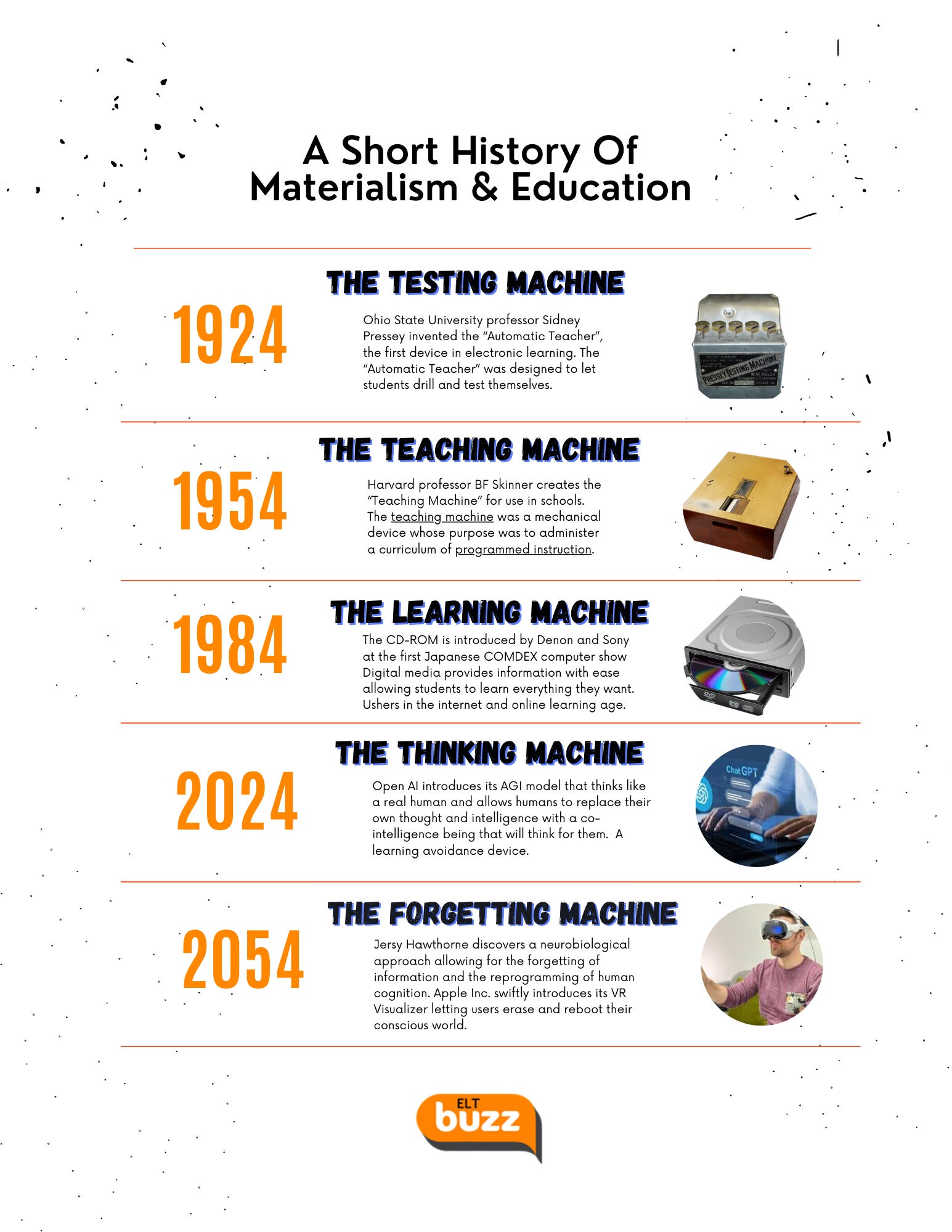
The hype of educational technology is nothing new (see below), it’s just more well funded, overwhelming and concerted this time. Don’t believe the hype, it is marketing. It’s all about $$$ and locking you into their ecosystem, attention arena.
“I think AI is going to be the greatest force for economic empowerment and a lot of people getting rich we have ever seen.” - Sam Altman hyptster sensationale
Here’s what I’m talking about when I say “hype”;
Scaremongering: If you don’t use X AI tool, you’ll fall behind. You won’t get into Harvard or Wharton. You won’t get a good job. You’ll just plain fail. Use it or lose. You’ll become technologically illiterate.
Aggrandisement: It overstates its capabilities. This ranges from “AI is conscious (I just spit out my mouthful of sandwich) to AI use accelerates student learning (confusing knowing with learning). Plus a ream of other claims that are just marketing skin.
Misinformation: Lies. AI didn’t steal IP (Intellectual Property). AI datacenters are clean and don’t harm the environment. AI will be free forever, for all schools, universities. AI “cares” about you. AI protects student data. I could go on forever. Just as LLMs hallucinate, AI companies outright lie to our faces.
Determinism: AI is inevitable. If you don’t use it, you are a castaway. If you don’t use LLMs, you will be left behind. There is no sense protecting your job, your current way of life, the onslaught of AI is inevitable.
Romanticism: AI is the glorious future of mankind. AGI is around the corner. Shiny, happy people use AI. Well all know nothing but be very happy. Sounds just like Soviet futurism … we know how that went.
Of course this is all poppycock. Emily Bender says some poignant things in this interview.
Language teachers should not dance to the AI hype playing pied piper nor learn its steps. AI has its uses but should be limited to where it actually, knowingly benefits student learning outcomes. Not solely for reasons of ease, speed, it’s there, fashion, cheating or mimicry. Learning is a messy, social, multi-faceted, deep, unconscious, slow, so human process. It will always remain so - don’t confuse it with superficial and processed knowledge.

And remember that ancient, invaluable adage …
If it is too good to be true, it probably is.
To end, I’ll leave you with an article I wrote in 2011 about educational tech hype. It includes some nice jokes as sweetener.
I read a lot about the “new paradigm” that is occuring in education. There is a lot for us teachers and particularly those in leadership positions to think about.
I really do hear some things repeated over and over again - that I just won’t buy into. I don’t believe the hype. These ideas, this hype seem so obvious and so clear that to me, they must be a lie. Reality is crooked and operates on her own principles - not the nice, clean kitchen cupboards we like to stack away our beliefs in.
So in brief and to maybe get others thinking a little “outside the box” - here are 4 things that are being hyped in the educational world that I disagree with completely. (and a joke for each that I hope will support my argument or if not, at least give you a chuckle)
1. The world is changing so fast.
Wooo there! It may appear that things are changing but as the old saying goes, “la plus ca change, la plus c’est la meme chose”. The more things change, the more they remain the same. Education still is about people, communication, knowing, doing.
We get too carried away in all the hype: how the world is changing at a stunning pace, we are educating for new jobs we don’t know about, technological tools arrive anew every day, the sky is falling etc....
I don’t buy into it. We still will need pen and paper, we still will have to talk with students and acquire knowledge that goes between our two ears. The hype only distracts us from the objective of education - to create a happy, caring and thoughtful person. I don’t care the decade or the hype. That will always remain THE goal.
Two Russians talking:
- Abram, why are you saving money ? Don’t you know that we are going to the Communism and when we get there no one will need any money at all.
- I am saving for my way back.
2. Testing, particularly standardized testing, is evil.
Testing will always be with us. We need it and it is particularly useful to students, teachers, administrators alike. Tests have their place. They aren’t evil.
The problem is not the test but teachers being told or directed to “teach to the test”. This should be the evil - not the test itself. In my years in education, contrary to the hype, most students benefit and like the tests - just not the classroom time spent teaching to a test.
Tests should measure the knowledge or performance of the student (as much as that is possible) but not be held up as some hurdle to jump over or some “place” to reach. They should provide information to both teachers and students about the process of learning. They are temporary and disposable - not something that we should record ad infinitium. That said, they aren’t evil - only how they are used.
Abram and his friend Saul are out for a walk. They pass a Catholic church with a sign out front, “$1,000 to Anyone who Converts.” Saul decides to go in and see what it is all about.
Hours go by. Finally he comes out and meets Abram. “So” says Abram, “What happened?”
“I converted”, said Saul.
“No kidding” says Abram. “Did you get the $1,000 bucks?”
Saul replied, “Is that all you people think about?”
3. Content is dead, information is everywhere. We don’t need to “know stuff”.
This one really gets my goat! Memorization, knowing will always be a vital part of intelligence. No matter how quick you can google something or how perfect the retrieval of information. Students still need stuff in their head to mix and churn and access in the quiet of their mind. Content will always be important.
We should still be thinking of what students need to know. There is a center that should hold. Around this, let the student learn skills and ways of processing this information. But let’s not abandon land to swim in water where we’ll never find our feet a place to stand....
A man is driving down the highway. A woman is driving up the same road. When they meet, the woman screams out the window, “Pig!” The man screams back, “Bitch!”
The man rounds the next corner, hits a huge pig in the middle of the road and dies.
4. Qualifications are a must. We need more diplomas, more certificates, tighter controls.
The world of education (and particularly ELT - English Language Teaching ) is going down a road that leads into a desert. There is a drive away from merit in our world and into “programs” and “credentials”.
I’m totally against this direction, for many sane reasons. The onus should always be on what a person can do, not what they did in a course . Credentials by default create barriers to real learning and to real discourse. They divide and create cliques. They restrict access based on financial ability and how things look on paper. They hinder by making knowledge about the cosmetic and not attuned to any reality (think of how many students you know with high TOEIC scores who can’t even order pizza over the phone in English).
A man walks into a pet store and asks to see the parrots. The store owner shows him two beautiful parrots. One for $5,000 and one for $10,000. The man asks, why the difference in price.
The store owner answers, “The first one sings every aria Mozart wrote. But the second, sings all of Mozart and Wagner too. “ “However, there is one out back for $30,000.”
“Holy cow!” the man says. “What can that parrot do?”
The man answers, “We don’t know, he’s totally quiet.” “But the other two call him Maestro.”